
Manufacturing automation is reshaping how factories operate and compete. What was once limited to high-volume production is now a practical move for businesses of all sizes seeking greater control over output, cost, and performance.
Several pressures are pushing this shift forward. Labour shortages are disrupting production, operating costs continue to climb, and global competition leaves little room for inefficiency.
At the same time, advances in digital technologies have made automation more accessible, allowing manufacturers to modernise without overhauling entire operations at once.
Yet, for many organisations, the path forward remains unclear. Where should you begin, and how do you ensure the investment delivers real value?
Achieve faster production with manufacturing automation for your business. Reach out to MMI Systems via email, call, or our contact formfor any enquiries!
What is Manufacturing Automation?
Manufacturing automation refers to the use of machines, control systems, and software to carry out production tasks with minimal human input or operations.
It allows manufacturers to move from manual processes to systems that can run with greater speed, precision, and consistent quality and higher output.
At the most basic level, machines handle single, repetitive tasks. As systems become more advanced, they can be programmed to manage batches of work with minimal intervention.
At the highest level, fully connected factories use data, sensors, and artificial intelligence to monitor performance and make decisions in real time.
Today’s automated factories are the result of steady development over time. Early manufacturing relied on mechanisation to reduce manual effort. This evolved into programmable systems that introduced flexibility.
In this age, Industry 4.0 brings connectivity, data, and intelligence together, allowing factories to operate with a higher level of coordination and insight.
Types of Manufacturing Automation
Manufacturing automation is not a single approach. It takes different forms depending on production needs, product variation, and scale. Understanding these types helps you choose the right setup for your operations.
Fixed (Hard) Automation
Fixed automation is designed for high-volume and repetitive production, where systems are built to perform a specific task with little variation, most commonly seen in assembly lines.
This approach delivers consistent output and stable quality at scale. However, once installed, it is difficult to modify. Any change in product design may require significant reconfiguration.
Flexible (Soft) Automation
Flexible automation allows systems to adjust to different products with minimal downtime. It is suited for environments where variation is frequent.
This approach supports mass customisation, enabling manufacturers to produce different products without stopping production for long changeovers.
Programmable Automation
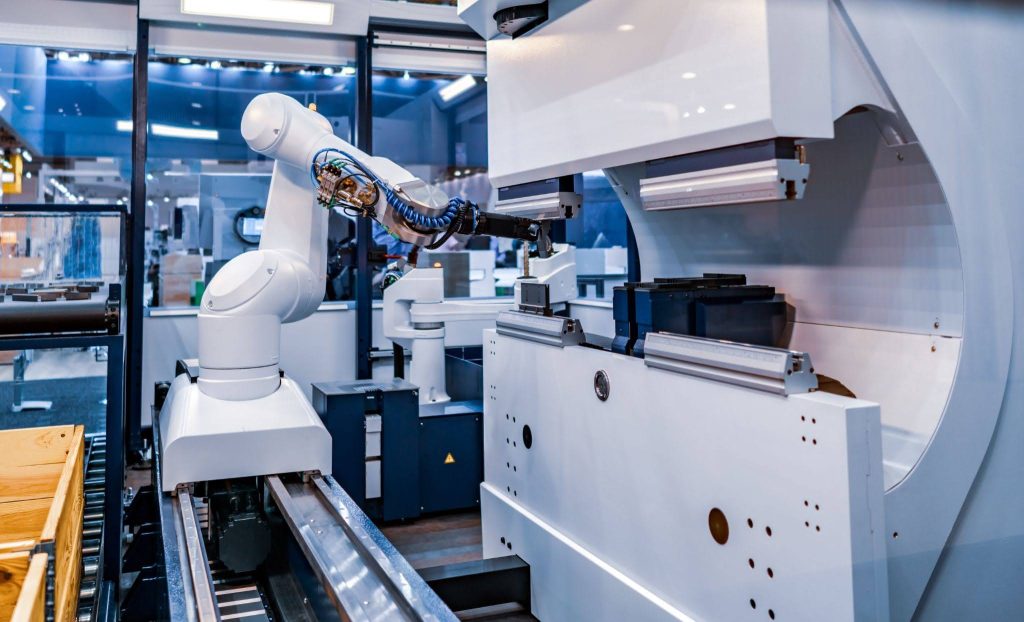
Programmable automation supports batch production by allowing equipment to handle different products or processes through reprogramming. For example, Collaboration Robots can switch between tasks based on instructions, providing flexibility while requiring some setup time for each change.
Integrated/Smart Automation
Integrated automation connects machines, systems, and data across the factory so that equipment no longer operates in isolation but as part of a coordinated system.
Data flows between machines in real time, while software analyses performance and triggers actions automatically. In advanced setups, artificial intelligence guides decision-making, enabling operations to respond to changes immediately.
Core Technologies Driving Manufacturing Automation
Manufacturing automation relies on several technologies that work together to enable operations to run more efficiently, accurately, and predictably.
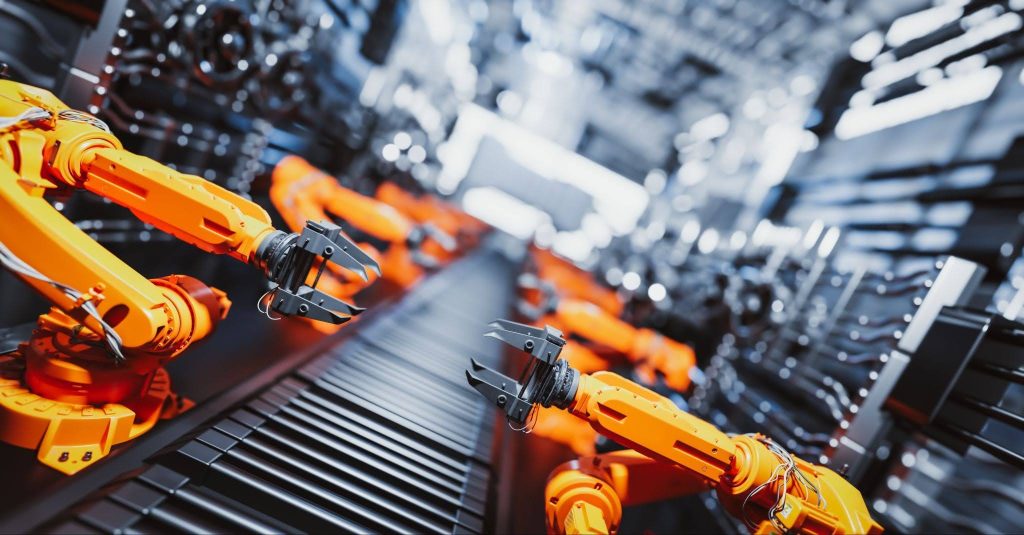
- Industrial robots handle tasks such as assembly, welding, and material handling, taking on work that is repetitive or precise.
- IoT and Industrial IoT (IIoT) connect machines and collect data from production processes, enabling monitoring and insights in real time.
- Artificial Intelligence and Machine Learning analyse patterns in data, optimise processes, and predict maintenance needs.
- Machine vision systems inspect products automatically, identifying defects and ensuring consistent quality.
- Automated Guided Vehicles (AGVs) and Autonomous Mobile Robots (AMRs) transport materials without manual intervention.
- Manufacturing Execution Systems (MES) track production progress, manage workflows, and integrate data across operations.
Digital twins simulate processes in a virtual environment, allowing testing and optimisation before changes are applied on the shop floor.
Benefits of Manufacturing Automation
Manufacturing automation delivers measurable improvements across operations. By reducing reliance on manual processes, factories can operate with greater speed, precision, and consistency.
- Higher productivity: Machines run continuously, completing tasks faster than manual methods.
- Consistent quality: Automation reduces human error and ensures products meet specifications.
- Lower costs: Less waste, reduced downtime, and optimised labour contribute to cost savings.
- Improved safety: Workers who may be affected by fatigue are removed from hazardous or repetitive tasks.
- Better visibility: Real-time data (such as yield, reject monitoring) provides insights that support informed decision-making.
Scalability: Systems can adjust to higher volumes or new products without extensive reconfiguration.
Challenges and Considerations
Implementing manufacturing automation requires careful planning to navigate both financial and operational challenges.
Upfront investment can be significant, not only for machines, software, and integration, but also because new automation often needs to work alongside legacy equipment, requiring adaptation or replacement to ensure smooth operation and protect the expected return on investment.
Automation also changes the workforce when roles are shifted, creating a skills gap that requires training and reskilling to maintain efficiency.
These new responsibilities, combined with evolving access to software and machines, can create potential cybersecurity risks if proper controls and training are not in place.
Other than technology, successful adoption depends on organisational readiness, where teams may resist new processes and a clear plan of strong leadership, structured implementation, and consistent communication are essential for a smooth transition.
How to Implement Manufacturing Automation
Implementing automation requires a structured approach. Rushing in without planning can lead to wasted investment, poor integration, or limited results. A clear process ensures each step adds value and reduces risk.
Assess Current Operations
Start by mapping your existing processes to identify repetitive tasks, bottlenecks, and areas prone to errors. Use these insights to set clear goals for automation, such as reducing costs, improving quality, or increasing production speed.
Develop an Automation Strategy
Prioritise areas where automation will deliver the greatest impact. Build a business case that outlines expected returns, costs, and timelines, providing a roadmap to guide technology selection and implementation decisions.
Choose the Right Technologies
Select solutions that match your operational needs without adding unnecessary complexity. Evaluate vendors based on integration capabilities, support, and proven results in similar operations, ensuring that the technology aligns with both current and future production requirements.
Pilot and Scale
Test automation on a small scale (by Proof Of Concept – POC methods) before a full rollout. A pilot project allows you to refine processes, resolve issues, and validate expected benefits. Once successful, gradually expand automation across other areas of production to minimise disruption and maximise value.
Train and Upskill Workforce
Automation changes roles rather than replacing people. Train staff to operate and manage new systems, and develop internal expertise to maintain and optimise automation over time. This ensures the workforce remains capable, engaged, and aligned with the new processes.
Value of Manufacturing Automation
Manufacturing automation delivers measurable business value by improving efficiency, reducing errors, and optimising resources.
While it requires investment in hardware, software, integration, and ongoing maintenance, the Return Of Investment (ROI) can be achieved over a period via tangible improvements across production.
Legacy equipment can affect how quickly this value is realised, as older systems may need adaptation or replacement to integrate seamlessly with new automation.
The true value emerges when savings and productivity gains are weighed against the investment. Automation can reduce labour costs, minimise waste, shorten downtime, and improve product consistency.
Calculating hidden costs, such as installation delays, staff training, and future upgrades, ensures a realistic understanding of the benefits.
By evaluating both costs and operational gains together, businesses can see the full impact of automation on their bottom line, making decisions that maximise efficiency, quality, and long-term competitiveness.
Future Trends in Manufacturing Automation
Manufacturing automation continues to evolve, creating opportunities for efficiency, flexibility, and business growth.
A key trend is Industry 5.0, which brings humans and machines closer together, combining human creativity with machine precision to improve decision-making and maintain operational control.
Building on this, AI-driven autonomous factories can monitor performance, predict maintenance needs, and adjust operations in real time, reducing downtime and increasing throughput.
These systems rely on hyperconnectivity and edge computing to process data near the source, enabling faster insights and quicker responses to changes on the shop floor.
At the same time, sustainability is becoming a central consideration, as energy-efficient automation and resource optimisation not only lower costs but also support environmental goals that matter to customers and regulators.
These advances make mass customisation at scale achievable, allowing businesses to deliver tailored products without sacrificing efficiency.
Conclusion
Manufacturing automation is no longer a future concept; it is a practical strategy that improves efficiency, quality, and operational control. Taking the first step, even on a small scale, allows businesses to test, learn, and scale automation effectively, ensuring each investment delivers tangible results.
By approaching automation strategically, manufacturers can build operations that are more resilient, adaptable, and prepared for the future.
Achieve faster production with manufacturing automation for your business. Reach out to MMI Systems via email, call, or our contact form for any enquiries!