Automation is no longer a choice in manufacturing. It has become the standard for companies that want to stay competitive, reduce errors, and scale production.
Within the industry, two main approaches dominate: factory automation and process automation.
While both aim to improve efficiency and quality, they work in different ways and serve different purposes.
Understanding the difference is critical. Choosing the wrong approach may fix only part of the problem, while the right one drives improvements in speed, consistency, and long-term competitiveness.
How Factory Automation Works on the Production Floor
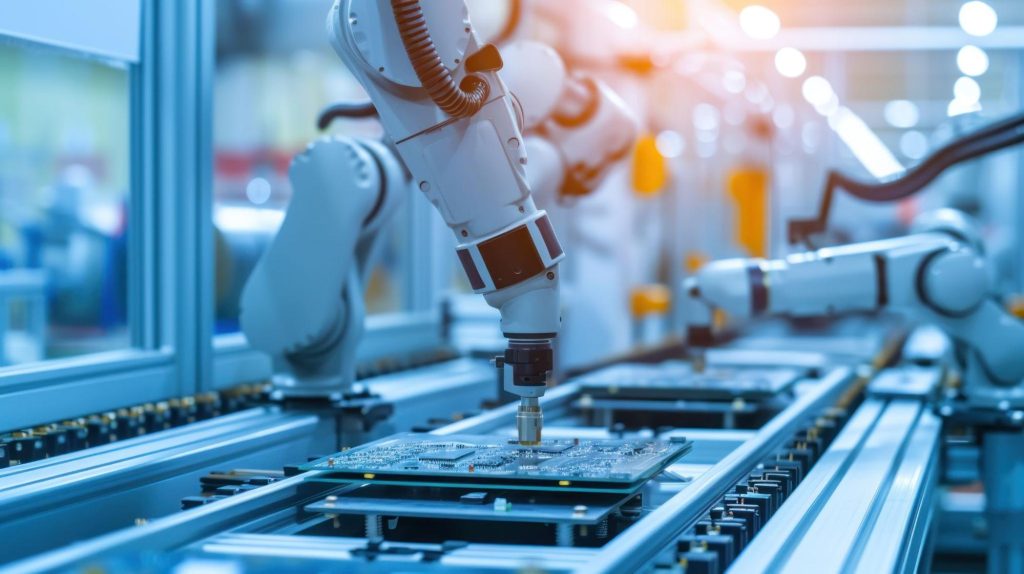
Factory automation focuses on replacing manual labour across the production floor with machines, robotics, and computer-controlled systems. It aims to improve speed, precision, and overall production capacity.
Examples of factory automation include:
- Robotic arms that assemble components at high speed and accuracy.
- Computer Numerical Control (CNC) machines that produce parts with consistent quality.
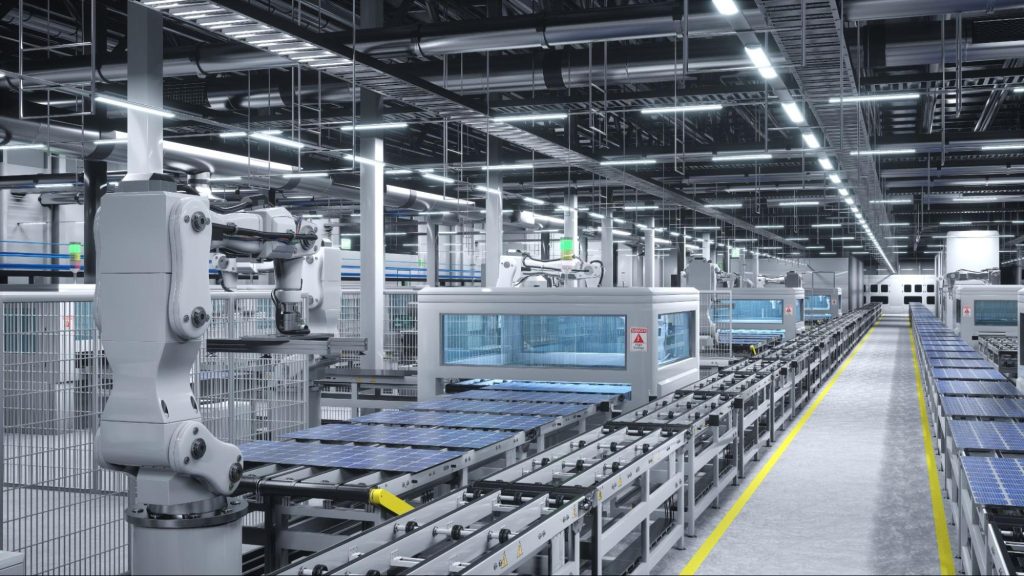
- Automated conveyor lines that move materials between stations.
- Automated Guided Vehicles (AGVs) that transport goods around the factory.
This level of automation transforms the factory into a highly efficient environment where machines handle most of the physical execution of tasks.
Three Main Types of Factory Automation
There are three main factory automation types. Businesses typically adopt one of three approaches depending on their needs:
- Fixed Automation
Designed for a single, high-volume task. It offers speed and efficiency but little flexibility. - Programmable Automation
Suitable for varying production runs. Products and volumes can be adjusted by reprogramming the system. - Flexible Automation
Provides the best adaptability with minimal downtime or cost, ideal for manufacturers handling diverse product lines.
How Process Automation Strengthens Business Operations
Process automation focuses on controlling, monitoring, and optimising specific steps in the production line. Instead of replacing workers across the entire factory, it ensures each process runs smoothly, safely, and consistently with minimal manual input.
Examples of process automation include:
- PLCs, PC-based control systems, and sensors that automatically regulate critical process parameters such as temperature, pressure, and flow rates.
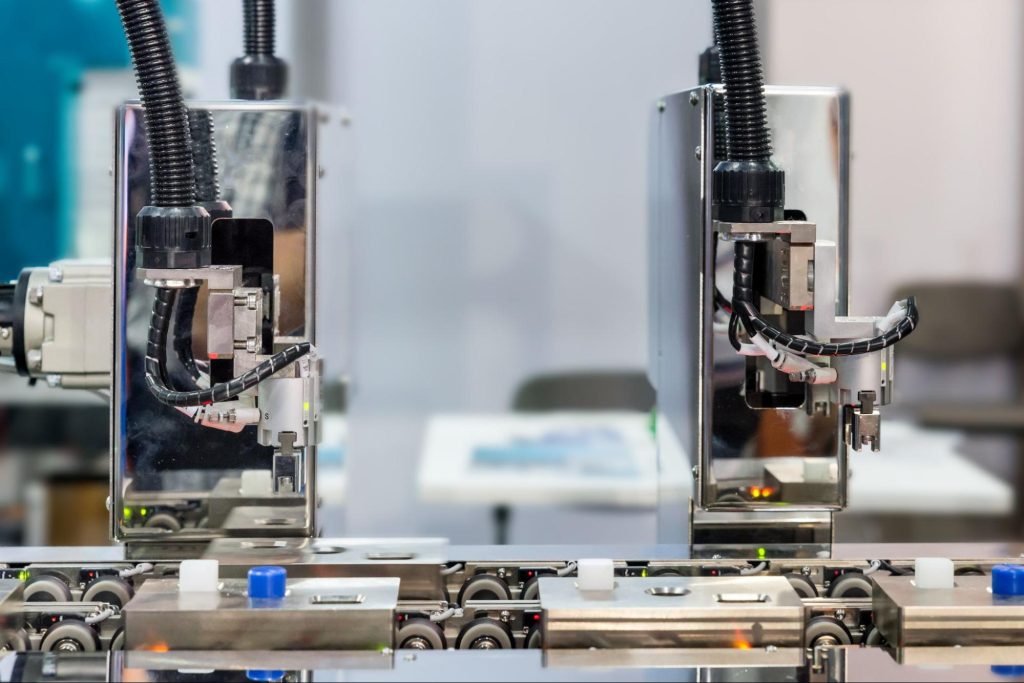
- Robotic process cells and precision pick-and-place systems, purpose-built for specific tasks like welding, assembly, or material handling.
- Automated quality inspection systems powered by AI and Deep Learning, capable of detecting defects in real time with high accuracy.
- Control loops and Industry 4.0-enabled systems that continuously monitor and adjust equipment settings to ensure consistent product quality and compliance with standards.
This type of automation ensures stability and consistency in critical operations. Hence, reducing waste, errors, and downtime.
Similarities That Often Confuse Businesses
Factory automation and process automation overlap in several areas. Which is why the terms are often used interchangeably. Both aim to boost productivity, reduce errors, and minimise manual labour. They also continue to rely on people for setup, monitoring, and adjustments.
Where they diverge is in scale and focus. Process automation is typically applied to specific operations or batches of work. Factory automation covers entire production lines or even the whole facility.
Example:
A factory may use robotic arms (factory automation) to assemble a product. While process automation ensures that materials arrive at the right station at the right time so the robot never stands idle.
How Automation Affects Quality and Consistency
Quality is one of the main drivers of automation. Factory automation improves accuracy and repeatability because machines perform tasks the same way every time. Research shows that automation can reduce human error and raise part-to-part consistency across machining, assembly, and inspection processes. However, synchronisation across multiple stations must be tightly managed. A delay or fault in one part of the line can ripple through the entire system. That is why process automation and in-line control are critical. They coordinate timing between machines, conveyors, and robots to prevent bottlenecks and idle time.
Another study shows that integrating sensors, automated control loops, and machine learning–based inspection enables real-time corrections that reduce variation and improve yields. Sensors and automated checks (for example monitoring temperature, pressure, or product dimensions) allow immediate adjustments and early rejection of off-spec parts, preventing small issues from becoming costly defects.
When machines and process controls remain aligned, the result is consistent, reliable output. The foundation of quality in modern manufacturing.
Deciding Which Automation Fits Your Needs
So which one should you prioritise? It depends on your goals.
- If your factory relies heavily on manual assembly and speed is your challenge, factory automation delivers the biggest gains.
- If your operations struggle with downtime, inconsistent handovers, or delays between machines, process automation creates immediate impact by keeping every step aligned.
For long-term competitiveness, the strongest results come from combining both. Machines run faster and more reliably, while process controls ensure smooth, consistent flow across the production line.
Why Manufacturers in Singapore Turn to Both
Singapore’s manufacturing sector faces rising costs and intense global competition. Companies are adopting automation that strengthens both machine operations and production flow to stay ahead.
- Electronics producers use robotic arms for assembly. While process automation synchronises conveyors and testers to keep every step in sequence.
- Food manufacturers automate packaging lines. While sensors and controllers monitor weight, sealing, and labelling in real time.
- Pharmaceutical firms deploy automated filling machines. The process checks track temperature, pressure, and dosage accuracy throughout the run.
By combining factory automation with process automation, manufacturers achieve efficiency from the first component to the final product. This combination reduces errors, cuts downtime, and ensures consistent output.
How We Support Your Automation Journey
At MMI Systems, we not only manufacture your capital equipment at scale based on your designs (Build to Print), but also develop customised automation solutions (Design and Build) tailored to solve real-world manufacturing challenges.
Every project begins with understanding your production needs. We then apply our design and manufacturing expertise to create solutions that raise efficiency, accuracy, and consistency on the factory floor.
Our capabilities include:
- Equipment Manufacturing Expertise
Covering automated material handling systems, complex full automation assembly lines, precision automation, machine vision, advanced control systems, and Automated Guided Vehicles (AGVs). - Development Engineering Support
From advanced mechanical and electrical design to robust software development. With tools like C++, Cognex Vision, and SECS/GEM protocols. - Industrial Compliance Knowledge
We ensure every system is designed and built to meet international safety and performance standards. Such as SEMI, NFPA, NEMA, and CE. - AI-driven Automation Solutions
Machine vision handles high-precision tasks such as alignment, measurement, and defect detection (cracks, scratches, dents, stains). Deep learning extends these checks beyond human capability.
AI-driven decision-making and digital twins optimise production and maintenance, while edge computing enables rapid, on-site responses without cloud delays.
Automation investments often deliver fast payback. Many companies experience ROI within 18 – 24 months, thanks to improved efficiency, reduced waste, and higher product quality.
When you work with us, you gain more than a solutions provider. You gain a long-term partner who combines technical expertise, industry compliance, and innovative AI-driven solutions to help your factory stay competitive in an evolving market.
See our full suite of services on the Capabilities & Services page.
Moving Forward with Automation
The decision is not about choosing factory automation over process automation, or vice versa. Both approaches play complementary roles. One elevates the factory as a whole, while the other ensures specific processes run with precision and consistency.
At MMI Systems, every automation project begins with a deep understanding of your production goals and process requirements. Leveraging our design and manufacturing expertise, we engineer solutions that elevate efficiency, precision, and consistency across the factory floor.
From precision pick-and-place robotics to AI-powered vision inspection systems, our technologies are built for flexibility and scalability – ready to adapt to future expansion and evolving demands – while upholding the highest standards of safety and reliability.
We provide the clarity, technology, and support to help you make the right move. Whether you are looking to automate your entire production floor or streamline critical processes, our solutions are built to guide you forward.
Reach out to us at mmisyg-enquiry@mmi.com.sg or through our online contact form. Our team will be ready to assist you with your business needs.