The Fourth Industrial Revolution or Industry 4.0 has been reshaping the technological landscape for the better part of a decade. While this rapid advancement was foreseen, many organisations were still unprepared for its impact.
Everything from the Internet of Things (IoT) to Artificial Intelligence (AI) constitutes a large part of Industry 4.0—but what actually is the Fourth Industrial Revolution, and why does it matter?
Understanding Industry 4.0
Industry 4.0 refers to the integration of digital technologies into traditional industrial and manufacturing capabilities. It’s a shift towards smart manufacturing, where machines, systems and humans are in a way, interconnected—often referred to as smart factories.
This highly data-driven environment is where faster and better decisions are made. Unlike previous industrial revolutions that focused on mechanisation or mass production, Industry 4.0 emphasises connectivity and automation.
A key component is the Industrial Internet of Things (IIoT). Sensors and actuators embedded in machinery collect real-time data, helping businesses monitor performance. Coupled with big data analytics and cloud computing, companies can make smarter, faster decisions across operations.
Key Industry 4.0 Technologies
AI and Machine Learning (ML)
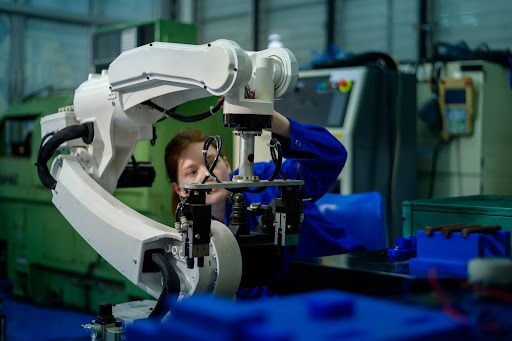
AI and ML are two core technologies when it comes to Industry 4.0. They enable machines and systems to learn from data and make intelligent decisions on their own. For example, AI can analyse data from machinery to anticipate failures before they occur.
ML also enhances quality control, allowing factories to automatically detect defects.
Internet of Things (IoT) and Industrial IT (IIoT)
The IoT connects devices and machines to share data in real time. In industrial settings, IoT evolves into IIoT, enabling fully connected factories where equipment can easily communicate with operators and management systems.
This connectivity also forms the basis for smart factories, allowing real-time data monitoring and human-machine collaboration.
Robotics and Autonomous Systems
Robotics and autonomous systems are transforming manufacturing floors. From assembling components to performing hazardous tasks, these technologies enhance safety and precision.
Combined with AI, autonomous robots can even adapt to changing production requirements.
Digital Twin and Simulation Technologies
Digital twin technology creates a virtual replica of a physical machine or process. This allows engineers to simulate changes and predict issues without interrupting actual operations.
When paired with Augmented Reality (AR) and Virtual Reality (VR), digital twins can also improve training and maintenance.
Cloud Computing and Edge Computing
Cloud computing enables factories to store large amounts of data. Edge computing on the other hand, processes data locally at the source, reducing latency issues. Together, these technologies allow for real time insights across all production lines.
Blockchain and Cybersecurity
As factories become increasingly connected, securing data becomes critical. Blockchain technology provides transparent and tamper-proof records, especially useful in supply chain digitalisation.
Strong cybersecurity measures will also protect connected enterprises from potential threats.
Benefits of Industry 4.0
- Better Efficiency: Automated systems lie at the heart of Industry 4.0. By using AI, factories can reduce human errors and speed up production. Tasks that once took hours or required constant supervision can now be completed faster and with consistent quality. This also allows companies to focus on innovation rather than repetitive work.
- Better Decision-Making: Thanks to real-time data monitoring and big data analytics, managers and engineers have instant access to insights from every part of the production line. This data-driven approach enables smarter strategies and decision-making that can improve overall operational performance.
- Cost-Savings: Predictive maintenance are game changers for cost reduction. By anticipating machinery issues before they happen, companies can avoid expensive downtime and reduce repair costs. Similarly, lean equipment manufacturing combined with intelligent automation helps cut waste, driving substantial savings across your company.
- Flexibility: With connected systems, businesses can easily adjust to changing market demands faster than ever. This is crucial considering how competitive businesses can get. It not only gives you a competitive edge, but also allows for smoother operations.
- Innovation: Perhaps the most exciting benefit of Industry 4.0 is its ability to unlock entirely new possibilities. Technologies like AI and advanced robotics are not just improving existing processes, but also enabling new services that were impossible before. The potential for innovation is virtually limitless, with newer technologies being designed and tested more than ever before.
Challenges With Industry 4.0
Industry 4.0 does come with its fair share of challenges. For starters, cybersecurity has become a major concern due to increased connectivity. Hackers can easily tap into connected systems to steal sensitive data or even sabotage machinery.
Another significant challenge is high implementation cost. While these systems can cut costs through predictive maintenance or automation, the initial investment can cost a lot. Small and medium-sized enterprises (SME’s) in particular, may find the upfront cost a challenge.
Workforce upskilling is also critical. This includes teaching employees how to operate and maintain these advanced machinery and equipment. Without proper training, your workforce and company as a whole will fail to realise the full potential of Industry 4.0.
The Future of Industry 4.0
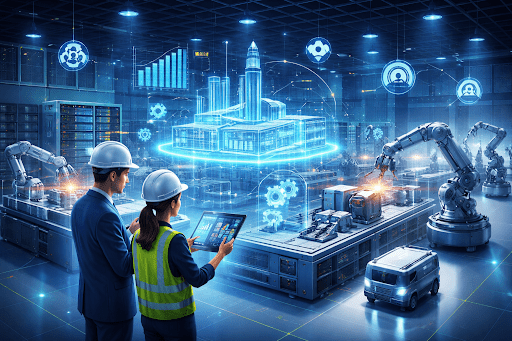
The future of industry 4.0 remains extremely promising. With AI being tested and improved everyday, it’s only a matter of time before fully autonomous factories and supply chains become a reality.
These factories will not only push the boundaries of productivity, but also redefine the way businesses operate. Human roles will shift from routine tasks to more problem solving activities.
The need for human employees might decrease all together, making industry 4.0 a double edged sword for the workforce.
Conclusion
Industry 4.0 is a revolutionary movement that focuses on the digital transformation in manufacturing. It leverages technology like AI, robotics and IoT to create smart factories that are more efficient and innovative.
These technologies not only improve the production process, but can also help your company reduce costs and make better decisions through predictive analytics and real-time data. With that said, Industry 4.0 does come with challenges.
This includes cybersecurity risks and high implementation costs to name a few. Ultimately, the future of Industry 4.0 remains bright, especially with the ongoing evolution of technology. Looking for a trusted partner to help you navigate Industry 4.0? Visit https://mmi-systems.com.sg/ or contact us to find out more!